


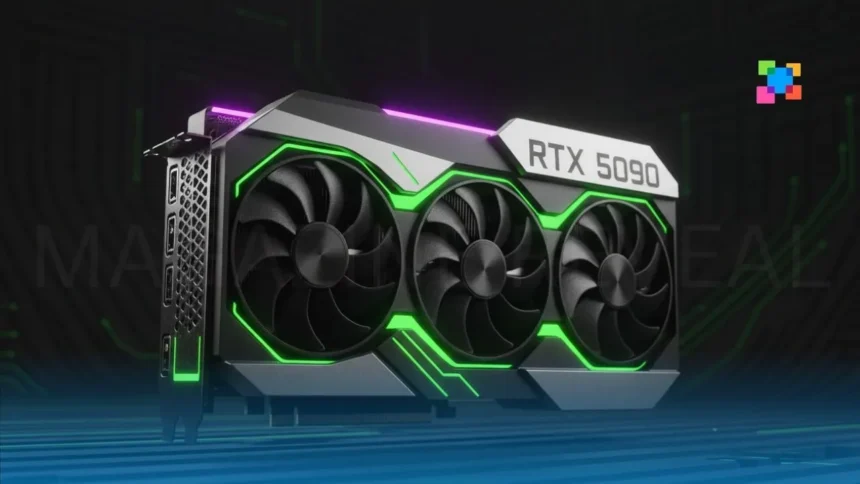
The graphics processing unit market continues to evolve as new technologies reshape gaming, content creation, and artificial intelligence workloads. The NVIDIA GeForce RTX 5090 represents the newest step in that evolution. Designed by NVIDIA, the RTX 5090 aims to deliver massive improvements in graphics performance, AI acceleration, and rendering efficiency. Gamers, creators, and developers now expect more from GPUs than ever before. They need higher frame rates, realistic lighting effects, faster processing power, and better support for advanced software technologies.
The RTX 5090 introduces innovations that push the boundaries of what modern GPUs can achieve. From improved ray tracing capabilities to faster memory technologies and AI-powered graphics rendering, this next-generation card sets a new standard for performance. As games grow more complex and creative applications demand greater computing power, GPUs like the RTX 5090 become essential tools for both entertainment and professional work. Understanding how this GPU works, what technologies it introduces, and how it compares to previous generations helps users determine whether it represents the right upgrade for their systems.
Evolution of NVIDIA’s RTX Graphics Cards
The RTX series of graphics cards has transformed the gaming industry since its introduction. Earlier generations introduced new technologies such as real-time ray tracing and AI-based upscaling, which significantly improved visual realism in games. Each new RTX generation brought improvements in processing power, efficiency, and software support. The RTX 5090 continues this trend by introducing even more advanced technologies and higher performance capabilities.
Over the years, GPUs have evolved from simple graphics accelerators into powerful parallel computing devices. Today’s GPUs support gaming, scientific simulations, machine learning, and creative production workflows. The RTX 5090 reflects this transformation by combining powerful gaming features with professional computing capabilities. By building upon previous RTX technologies, NVIDIA continues to push the limits of graphics performance while expanding the role of GPUs in modern computing environments.
What Makes the RTX 5090 a Next-Generation GPU?
Several factors distinguish the RTX 5090 as a true next-generation graphics card. First, it introduces a new GPU architecture that improves efficiency and increases processing capabilities. This architecture allows the GPU to execute more operations simultaneously, resulting in faster rendering and smoother gameplay. Combined with advanced AI technologies, the RTX 5090 can deliver impressive graphics quality while maintaining high frame rates.
Another defining characteristic of the RTX 5090 is its ability to support emerging technologies such as advanced ray tracing, AI frame generation, and ultra-high-resolution gaming. These features allow developers to create more immersive digital environments while maintaining excellent performance. As gaming engines continue to evolve, GPUs must provide the processing power needed to handle complex visual effects and massive open worlds. The RTX 5090 meets these demands by delivering the performance required for next-generation gaming experiences.
New GPU Architecture Behind RTX 5090
The RTX 5090 introduces an advanced GPU architecture designed to maximize performance and efficiency. Modern GPUs rely on highly parallel computing structures that allow thousands of processing units to work simultaneously. This architecture improves data processing speeds and enables the GPU to handle complex calculations required for modern graphics rendering. With improved transistor density and optimized data flow, the RTX 5090 processes graphics workloads faster than previous generations.
Another advantage of the new architecture lies in its improved AI processing capabilities. Modern games and creative applications rely heavily on machine learning algorithms for image reconstruction, frame generation, and performance optimization. The RTX 5090 integrates enhanced AI tensor cores that accelerate these calculations. This allows developers to create more sophisticated graphics engines and enables gamers to experience smoother gameplay with improved visual quality. The architecture therefore supports both current gaming needs and future technological advancements.
Major Hardware Upgrades in the RTX 5090
The NVIDIA GeForce RTX 5090 introduces several significant hardware upgrades that dramatically improve overall GPU performance. One of the most notable enhancements involves increased transistor density, which allows the chip to include more processing units without increasing physical size excessively. These additional components improve parallel computing capabilities and allow the GPU to handle more tasks simultaneously. Improved silicon design also enhances efficiency, meaning the card can deliver higher performance without proportionally increasing power consumption. Such improvements help modern gaming systems achieve higher frame rates while maintaining stability during demanding workloads.
Another key hardware upgrade lies in memory bandwidth and data transfer efficiency. Faster memory controllers allow textures, lighting calculations, and physics simulations to move quickly between GPU components. This reduces bottlenecks and ensures smoother performance in graphics-intensive environments. Hardware improvements also include enhanced cooling compatibility and refined PCB layouts that support better power delivery. These design enhancements make the RTX 5090 capable of handling high-performance gaming sessions, professional rendering projects, and AI computing workloads without compromising reliability or system stability.
CUDA Cores and Processing Power Explained
CUDA cores represent the primary processing units inside NVIDIA graphics cards. In the RTX 5090, these cores handle most of the mathematical operations required for rendering images, calculating lighting effects, and simulating complex physics systems. A higher number of CUDA cores allows the GPU to process more instructions simultaneously. This parallel processing capability significantly improves performance in both gaming and professional workloads such as video editing and 3D modeling.
The increased number of CUDA cores in the RTX 5090 ensures that demanding tasks execute faster and more efficiently. Modern game engines rely heavily on GPU processing power to render complex environments, dynamic lighting, and advanced physics simulations. With thousands of CUDA cores operating simultaneously, the RTX 5090 can generate high frame rates while maintaining visual fidelity. This improvement makes the card particularly attractive for enthusiasts who want smoother gameplay and professionals who require powerful computing resources for creative projects.
AI Acceleration and Neural Processing Improvements
Artificial intelligence has become an important component of modern GPU technology. The RTX 5090 integrates enhanced AI acceleration features that allow the GPU to perform complex machine learning calculations more efficiently. These improvements support tasks such as image reconstruction, noise reduction, and real-time performance optimization. By integrating specialized hardware designed for AI processing, NVIDIA enables the RTX 5090 to deliver improved performance in both gaming and productivity applications.
Neural processing capabilities also enhance real-time graphics rendering. AI algorithms can predict and generate additional frames, reconstruct high-resolution images from lower-resolution data, and optimize resource allocation across GPU workloads. These capabilities help maintain smooth performance even when running demanding applications. Developers can also use the RTX 5090’s AI hardware to accelerate machine learning research, making the GPU valuable not only for gamers but also for scientists, engineers, and developers working with artificial intelligence technologies.
DLSS Technology and AI Frame Generation
Deep Learning Super Sampling (DLSS) represents one of the most innovative technologies introduced by NVIDIA in recent years. DLSS uses artificial intelligence to upscale lower-resolution images into higher-resolution frames while preserving image quality. This technique allows games to run at higher frame rates without sacrificing visual detail. The RTX 5090 improves DLSS capabilities by integrating more powerful AI tensor cores capable of handling complex image reconstruction algorithms.
AI frame generation further enhances gaming performance by creating additional frames between rendered images. Instead of relying solely on traditional rendering methods, the GPU predicts intermediate frames using machine learning models. This approach significantly increases frame rates while maintaining smooth gameplay. As gaming monitors continue to support higher refresh rates, technologies like DLSS and AI frame generation become essential tools for delivering fluid visual experiences without overloading system resources.
Ray Tracing Innovations in the RTX 5090
Real-time ray tracing has become a defining feature of modern graphics technology. The RTX 5090 includes improved ray tracing cores designed to calculate realistic lighting, reflections, and shadows in real time. These calculations simulate how light behaves in the real world, producing highly realistic visuals in games and digital environments. With faster ray tracing hardware, the RTX 5090 can render complex lighting effects without sacrificing overall performance.
Advanced ray tracing capabilities also benefit professional applications such as film production, architectural visualization, and product design. Designers can simulate accurate lighting conditions and realistic materials during the rendering process. The RTX 5090 accelerates these tasks, reducing the time required to generate high-quality visual results. By improving ray tracing performance and efficiency, NVIDIA continues to push the boundaries of photorealistic graphics in both entertainment and professional creative industries.
VRAM Capacity and High-Speed Memory Technology
The NVIDIA GeForce RTX 5090 introduces significant improvements in VRAM capacity and memory speed, allowing the GPU to manage massive graphical workloads efficiently. Modern games use extremely detailed textures, large environments, and complex visual effects. These elements require large amounts of video memory to operate smoothly. The RTX 5090 addresses this demand by incorporating next-generation memory technology that increases both capacity and bandwidth. This enables the GPU to store more graphical data locally, reducing reliance on slower system memory and improving overall performance.
Another important improvement lies in the adoption of faster memory modules such as GDDR7. This memory technology dramatically increases data transfer speeds between the GPU and its memory system. Higher bandwidth allows the GPU to process large textures and complex graphical calculations without bottlenecks. For gamers, this results in smoother gameplay and improved visual quality. For professionals working with 3D rendering, animation, or video production, the increased VRAM capacity ensures large projects can be handled more efficiently without slowing down the system.
Gaming Performance in Modern AAA Titles
Modern AAA games demand powerful hardware to deliver smooth performance and high visual fidelity. The RTX 5090 is designed specifically to meet these demands by providing significant improvements in processing power and rendering efficiency. With thousands of CUDA cores and advanced AI acceleration, the GPU can handle detailed environments, dynamic lighting systems, and complex physics simulations simultaneously. As a result, gamers can experience smoother frame rates and enhanced visual quality when playing the latest titles.
Developers continue to push the boundaries of game design by creating expansive open worlds, realistic character models, and advanced environmental effects. These features require a powerful GPU capable of maintaining high frame rates even during intense gameplay sequences. The RTX 5090 provides the performance needed to support these demanding game engines. Players benefit from reduced lag, faster rendering times, and a more immersive gaming experience that brings modern virtual worlds to life.
High-Resolution Gaming: 1440p, 4K, and 8K
High-resolution gaming has become a major focus for hardware enthusiasts and developers alike. Many modern gaming monitors now support 1440p and 4K resolutions, while some high-end displays are beginning to adopt 8K technology. The RTX 5090 is designed to handle these resolutions effectively by delivering the processing power required to render detailed images at extremely high pixel counts. With advanced AI upscaling technologies, the GPU can maintain excellent performance even at demanding resolutions.
Gaming at 4K resolution requires the GPU to process more than eight million pixels per frame. When running at high refresh rates, this workload becomes extremely demanding. The RTX 5090 addresses this challenge through improved rendering efficiency and powerful AI-driven technologies such as DLSS. These technologies reduce the computational burden while preserving image quality. As a result, gamers can enjoy ultra-sharp visuals and smooth gameplay even when running games at extremely high resolutions.
Thermal Design and Advanced Cooling Systems
High-performance graphics cards generate significant heat during operation. To maintain stable performance, GPUs require advanced cooling systems that dissipate heat effectively. The RTX 5090 features an improved thermal design that supports efficient heat management during long gaming sessions or professional workloads. Manufacturers often equip these GPUs with multiple cooling fans, vapor chamber technology, and optimized airflow pathways that keep temperatures within safe operating limits.
Efficient thermal design not only protects hardware components but also helps maintain consistent performance. When GPUs overheat, they often reduce clock speeds to prevent damage, which can impact performance. By improving heat dissipation, the RTX 5090 allows the GPU to sustain high performance levels for longer periods. Gamers and professionals benefit from a more stable system that remains responsive even during demanding applications such as high-resolution rendering or extended gaming sessions.
Power Efficiency and Energy Management
Power efficiency has become an important factor in modern GPU design. While high performance remains the primary goal, manufacturers must also ensure that GPUs operate efficiently without consuming excessive electricity. The RTX 5090 introduces improved power management technologies that optimize energy usage during both heavy workloads and idle states. These improvements allow the GPU to deliver impressive performance while maintaining reasonable power consumption levels.
Advanced energy management systems dynamically adjust GPU performance based on workload demands. When users perform lighter tasks such as browsing or watching videos, the GPU reduces power consumption automatically. During gaming or rendering workloads, the system allocates additional power to maintain peak performance. This intelligent power management helps extend hardware lifespan and reduces energy costs for users who rely on high-performance computing systems for extended periods.
RTX 5090 for Content Creators and Professionals
The NVIDIA GeForce RTX 5090 is not just a gaming powerhouse it also caters to content creators and professionals. Video editors, 3D animators, and graphic designers benefit from the GPU’s accelerated rendering capabilities. Tasks like real-time video encoding, 3D scene processing, and complex simulations are completed faster due to increased CUDA and tensor core performance. These improvements reduce project turnaround times, enabling creatives to work more efficiently without compromising visual quality or workflow precision.
Professional software often relies on GPU acceleration for high-resolution and high-frame-rate content. Applications such as Adobe Premiere Pro, Blender, and Autodesk Maya leverage the RTX 5090 to handle complex timelines, volumetric lighting, and multi-layer effects. By integrating AI-enhanced features and high-speed memory, the GPU allows professionals to preview results in real time. This capability enhances productivity, supports innovation, and ensures that creative professionals have the power required to meet industry standards for modern multimedia production.
GPU Performance for AI, Data Science, and Rendering
Artificial intelligence and data science workloads are increasingly GPU-dependent. The RTX 5090 excels in these areas due to its advanced tensor cores, CUDA cores, and high memory bandwidth. Training neural networks, running deep learning models, or performing data-intensive simulations are executed faster compared to prior GPU generations. Researchers, AI engineers, and data scientists can process massive datasets efficiently, reducing computation time from days to hours in some cases.
Rendering applications also see performance gains with the RTX 5090. 3D rendering engines, architectural visualization software, and photorealistic animation pipelines benefit from improved parallel processing and ray tracing capabilities. The GPU accelerates both GPU and AI-driven rendering methods, allowing professionals to produce complex, high-quality outputs more efficiently. This dual-purpose performance highlights the versatility of the RTX 5090, making it an essential tool for both scientific and creative industries.
Comparison with Previous RTX Generations
Compared to its predecessors, the RTX 5090 represents a significant leap in GPU technology. The card features enhanced architecture, more CUDA and tensor cores, faster memory, and improved AI acceleration. Gaming performance sees substantial improvement, with higher frame rates, smoother ray tracing, and better handling of ultra-high-resolution content. Users upgrading from earlier RTX models can expect noticeable gains in both gaming and professional workloads.
Efficiency improvements are also evident when comparing generations. Power management and thermal design enhancements allow the RTX 5090 to deliver peak performance without excessive energy consumption. Previous RTX GPUs required compromises between performance and heat management, but the 5090 balances these factors more effectively. Overall, the card demonstrates how NVIDIA continues to refine its architecture, enabling users to enjoy both advanced performance and reliability in modern applications.
RTX 5090 vs Competing GPUs in the Market
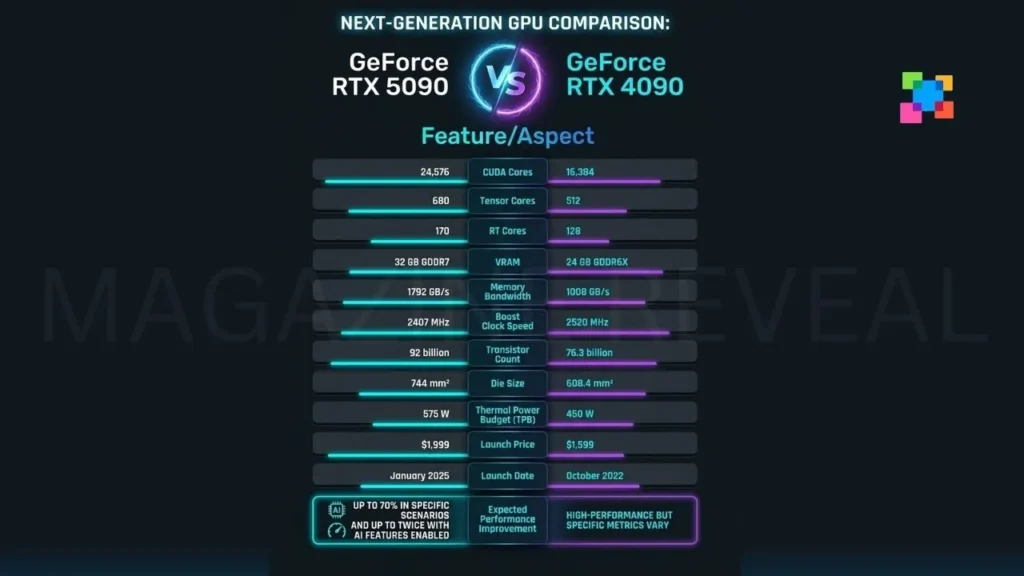
The RTX 5090 faces competition from AMD’s latest Radeon GPUs and other high-performance graphics cards. While AMD offers strong price-to-performance ratios, NVIDIA’s ecosystem provides distinct advantages, including superior AI acceleration, DLSS technology, and industry-optimized drivers. These features allow the RTX 5090 to maintain an edge in gaming, rendering, and scientific computing tasks.
Software optimization further differentiates NVIDIA GPUs from competitors. Many professional applications and AAA game engines are specifically optimized for CUDA and RTX technologies, giving the RTX 5090 superior performance in these scenarios. While alternative GPUs may provide similar raw power, the combination of hardware, software, and AI capabilities ensures that NVIDIA maintains a leadership position in both gaming and professional computing markets.
Future Gaming Technologies Supported by RTX 5090
The RTX 5090 is designed to support upcoming gaming technologies and industry standards. Next-generation ray tracing engines, AI-driven graphics, and high-refresh-rate monitors all benefit from the GPU’s capabilities. Developers creating immersive virtual worlds or photorealistic environments can leverage the GPU’s advanced rendering power to deliver high-quality experiences without compromising performance.
In addition, AI-powered tools like DLSS and frame generation will continue evolving alongside GPU hardware. The RTX 5090 is future-proofed for these technologies, ensuring compatibility with upcoming game releases and software updates. By combining raw processing power, AI acceleration, and next-generation graphics support, the RTX 5090 positions itself as a long-term solution for gamers and professionals seeking cutting-edge performance.
Should You Upgrade to the RTX 5090?
For gamers, content creators, and AI professionals, upgrading to the NVIDIA GeForce RTX 5090 offers substantial benefits. Users running older GPUs may experience lower frame rates, slower rendering times, and limited support for advanced features like ray tracing and AI frame generation. The RTX 5090’s performance leap ensures smoother gameplay, faster creative workflows, and improved AI processing, making it a strong choice for anyone seeking to maximize system capabilities and future-proof their setup.
However, the upgrade decision depends on individual needs and budgets. If users already possess high-end RTX 4000-series GPUs, the performance gain may be incremental. Those primarily gaming at 1080p with mid-range GPUs may find the cost-to-benefit ratio less compelling. Professionals working with large datasets, 3D rendering, or next-gen AAA games stand to benefit most. Evaluating system compatibility, power requirements, and intended use ensures users make a smart upgrade decision tailored to their specific computing demands.
Final Thoughts on NVIDIA’s Next-Generation GPU
The RTX 5090 demonstrates NVIDIA’s commitment to next-generation computing, blending gaming power, AI acceleration, and professional-grade performance. Its architecture, memory upgrades, and advanced ray tracing capabilities set a new benchmark for high-end GPUs. By supporting emerging technologies such as AI frame generation and ultra-high-resolution gaming, the RTX 5090 provides users with both immediate performance gains and long-term future-proofing for evolving software demands.
This GPU exemplifies the balance between raw performance and efficiency, offering high processing power while maintaining intelligent energy management. Whether used for immersive gaming, demanding creative workloads, or AI research, the RTX 5090 delivers exceptional results. NVIDIA has designed a versatile, high-performance graphics card that appeals to enthusiasts, professionals, and early adopters looking to experience the latest in GPU innovation.
Conclusion
The NVIDIA GeForce RTX 5090 is a transformative graphics card that combines advanced hardware, AI-driven features, and next-generation gaming support. It addresses the demands of modern AAA games, high-resolution content creation, and professional AI applications. With improvements in CUDA cores, memory speed, and thermal design, the RTX 5090 sets a new standard for performance, efficiency, and versatility in the high-end GPU market.
Gamers and professionals alike benefit from enhanced frame rates, realistic ray tracing, DLSS, and AI-accelerated workflows. NVIDIA’s strategic improvements in architecture and power management ensure stability and longevity, making the RTX 5090 a compelling option for anyone seeking top-tier GPU performance. Its combination of cutting-edge features and practical utility solidifies its place as a next-generation graphics powerhouse capable of meeting diverse computational needs.
Frequently Asked Questions
What makes the RTX 5090 different from previous RTX GPUs?
The RTX 5090 has more CUDA and tensor cores, faster memory, improved AI acceleration, and better ray tracing performance. It is designed for higher frame rates and professional workloads.
Is the RTX 5090 suitable for content creators and AI workloads?
Yes. Its enhanced AI cores, memory bandwidth, and CUDA cores accelerate rendering, video editing, 3D modeling, and AI model training efficiently.
Can it handle 8K gaming?
Yes. The RTX 5090’s high VRAM and processing power allow 8K gaming with advanced features like ray tracing and DLSS, although system configuration and settings impact performance.
Is it worth upgrading from an RTX 4000 series GPU?
For gamers or creators using high-end 4000 series GPUs, improvements may be incremental. Those with older or mid-range GPUs will notice significant gains in performance and efficiency.
VISIT MORE: MAGAZINE REVEAL